
Sunday, 2 March 2014
On the Fashion Sense of Sarah, Isaac's mother

Sunday, 16 February 2014
On Loving Machine Compassion

I love the idea of Hunger To Hunger, a project to translate a poem in and out of English several times. Many people have done similar things with Google Translate, which makes it easy, though it lacks the linguistic elegance brought by a human translator with some poetic skill.
I used Google Translate to take Richard Brautigan's poem All Watched Over By Machines Of Loving Grace (which seemed an appropriate choice for such an exercise) from English to French to Czech to Danish to German to Japanese to Hebrew to Indonesian to Hindi to Arabic and then back to English. I was impressed by how well the poem held up, a testament to how well Google Translate works these days. I played with this sort of thing years ago and it used to destroy the original completely.
The original and translation are listed below. I tried to set the two versions side by side line by line, but of course this might be messed up on your browser. The only change I made was to delete the word 'In' from the end of the translated title.
No one would say the translated version was an overall improvement from the original, but I do believe that some of the simple spare prose in the translation is the way to go. For example, I think Brautigan's ponderous lines
I like to think
(it has to be!)
of a cybernetic ecology
where we are free of our labors
are better rendered as
I love
(A must!)
Environment cybernetic
Where we are without work
All Watched Over By Machines Of Loving Grace Grace Loves Almost Every Machine
I like to think (and (I like to think
the sooner the better!) The more the better!)
of a cybernetic meadow Pasture cybernetic
where mammals and computers Computer with mammals
live together in mutually I live with one another
programming harmony Programming and harmony
like pure water Clean Water
touching clear sky. Touched the sky is clear.
I like to think I love
(right now, please!) (Now, please!)
of a cybernetic forest Forest cybernetic
filled with pines and electronics Filled with pines and electronics
where deer stroll peacefully Where deer go in peace
past computers By the computer
as if they were flowers Such as interest
with spinning blossoms. Spinning with flowers.
I like to think I love
(it has to be!) (A must!)
of a cybernetic ecology Environment cybernetic
where we are free of our labors Where we are without work
and joined back to nature, He returned naturally
returned to our mammal Back to our mammals
brothers and sisters, Ladies and Gentlemen,
and all watched over View All
by machines of loving grace. I love machine compassion.
Saturday, 8 February 2014
On a Human Document

[Image from http://humument.com/gallery/recent/i/hum-200503-06-500.jpg]
Saturday, 25 January 2014
On Automating Jenny Holzer

| believing something can make reality more intelligible |
| a man can't know what it is to be proud of knowing yourself |
| personal gain potential counts for nothing but a restatement of the old |
| lack of charisma can be a useful motivating force |
| investigation is a kind of anesthesia |
| a natural law governing the new is dangerous as complacency |
| morals are crackpots |
| government is a burden on the people who go crazy |
| decadence can be a meal ticket |
| you should study as much as possible your parents |
| believing in rebirth is the most elegant weapon of the old |
| change anything anyway |
| what is dominant in a culture is escapism |
| sexless old friends are better left in the occasional debauch sacrifice |
| principles are more valuable than a famous person |
| you don't know what's interesting is the appropriate response to most people |
| dreaming while awake is absurd violence |
| playing it safe can cause a lot of damage in the bank |
| imposing order is man's fate |
| attractive dying should be advanced at all costs |
| a nice idea of transcendence is a prerequisite of success |
| disorganization is more important than metaphor |
| most people are not fit to rule the mundane |
| extra money creates taste monomania |
| the new is nothing except what you sense |
| repetition is the best way to live in harmony with inferior people |
| you are the unattainable |
| stasis is a legitimate area of investigation |
| wholesome men don't protect you anymore |
| you should act like money in the bank hiding your own business |
| noise can be a form of freedom |
Monday, 20 January 2014
On Three Books With The Same Name

The original 'book' named The Bride Stripped Bare By Her Bachelors, Even (La Mariée Mise à Nu Par Ses Célibataires Même) was Duchamp's somewhat book-like collection, also known as 'The Green Box', which was published in 1934 in an edition of 320 copies. It consists of a compilation of facsimiles of Duchamp's enigmatic notes (written between 1911 and 1915) for his sculpture The Bride Stripped Bare By Her Bachelors, Even, after which I named my novel.
Duchamp claimed to have gone to what seems like absurd lengths to reproduce the notes exactly like the originals, down to the type and shape of paper, and the ink. However, modern scholarship, which has access to the original notes as well as his allegedly 'exact copies', has cast doubt on this claim. Many of the ink and paper types simply don't match and have perhaps even been systematically changed (details are here).
The notes in The Green Box have been republished in various forms, perhaps most notably in Richard Hamilton's excellent typographic English translation, also titled The Bride Stripped Bare By Her Bachelors, Even (though subtitled A typographic version), which the characters in my novel make sure they have with them when they go on a road trip from Medford, MA to Philadelphia, PA.
It seems to have clearly been Duchamp's intent that his notes to The Bride Stripped Bare By Her Bachelors, Even should be considered in some sense as part of the sculpture, to prevent anyone from thinking they might have just a purely visual relationship to it. You can't just look at the piece. You have to think about it. That is what makes it great.
Monday, 6 January 2014
On Nudity Across Time

[Image from www.wired.com]
Saturday, 4 January 2014
On What To Read While You Are Dying

There are advantages both to dying quickly and dying slowly. One advantage of dying quickly is that you can avoid the physical and mental suffering that often goes along with dying slowly. One advantage of dying slowly, however, is that you get to choose what to read as you are dying.
If I am given the opportunity to die slowly, I am going to read Simone Weil's Gravity & Grace while I die. I love Weil's strange and wonderful brand of Jewish/Catholic mystic Existential spirituality. She has lots of good advice for dying slowly, such as but not limited to the following:
- "The death agony is the supreme dark night which is necessary for the perfect if they are to attain absolute purity, and for that reason it is better that it should be bitter."
- "I am also other than what I imagine myself to be. To know this is forgiveness."
- "Grace fills empty spaces, but it can only enter where there is a void to receive it, and it is grace itself which makes this void."
- "There is, as it were, a phagocytosis of the soul: everything that is threatened by time secretes falsehood in order not to die, and in proportion to the danger it is in of dying. That is why there is not any love of truth without an unconditional acceptance of death."
- "We must give up everything that is not grace and not even desire grace."
- "Time and the cave. To come out of the cave, to be detached means to cease to make the future our objective."
- "May God grant that I become nothing. In so far as I become nothing, God loves Himself through me."
[Image: Altered illustration from Eugene Talbot's (1898) Degeneracy]
Monday, 30 December 2013
On Automatically Generating Character Names

- A woman named Gilda "Stunning Chemical" Lumpthoud.
- A Buddhist named Kristie Humpella Unschooled, Sr.
- A man named Sung Mouserood.
- A woman named Saundra Inane Sigmund Freud-Hank.
- A man named Arthur Pittman-Pup Warm "The Idiotic Dog" Larker.
- A checkout clerk named Amparo Puntalina Pope.
- A woman named Norma Burpcoyde.
- A personal woman named Poetic Goof.
- A man named Archie MacPeculiar "Rank Acidic-Sole" Murki.
- A man named Brant Von Moody.
- A woman named Mari "Grubby Dauber" Cockroachcell.
- A woman named Kasey Shoe "The Sugar-Free Honey" Von Chowderhead.
- A ruler named Jodie Goyie Shamauskas.
- A personnel officer named Luther Zebrajeh.
- A man named Carmen Freak.
- A man named Lewis Sikhella Mariana Roofellesity.
- A concessionaire named Ivory Ingram-Ashley.
- A woman named Reverend Lucille Turnson Noif, MA.
- A woman named Fern Insipid Watkins.
- A installer named Daub-daub Bellie Otternest.
- A despot named Tenssho Tigerchi
- A man named Woodrow Spotorda.
- A cryptographer named Lend Assiassibosk.
- A woman named Reverend Sparrow Taylor "The Cat-Damned" Pitiful, BSc.
- A man named Reverend Donald Harter.
- A man named Miles Rat Bush.
- A woman named Retesi Oifoifholy.
- A man named Lustful Greer.
- A woman named Fey-fey Wayward Elki.
- A woman named Elva Apollo McHolmes.
- A domestic named Soto "Fanciful-Eyebrow" Workman.
- A man named Faoge Guminheot O'Zipperhead.
- A jolly woman named Esperanza Fencdo.
- A woman named Greasy Gashson Miller-Blair.
- An anxious man named Sensual Tiltalina Turding Otter.
Saturday, 28 December 2013
On Living Well

PC: What do you mean?
CT: He wasn't telling you how to live so much as he was just trying to find out for himself. His friend Henri-Pierre Roché once said Duchamp's greatest work was his use of time."
Calvin Tomkins (2013)
Marcel Duchamp: The Afternoon Interviews. p. 19
[PC = Paul Chan. CT = Calvin Tomkins]
Sunday, 22 December 2013

Thursday, 12 December 2013
On Naming Nothingness

When we turn off the lights we should say we are turning on the darkness. When we end a relationship, we should say we are enabling solitude. When we die, let it be said that we have just switched on our nothingness.
[I plagiarized this blog post from my own FaceBook post, December 12, 2013]
Wednesday, 11 December 2013
On the Most Dangerous, Least Useful Thing

In my day job as a research psychologist, I study how human beings process language. I use many methods, one of which is to model semantics using a co-occurrence model of semantics. These computational models bootstrap word meaning by quantifying patterns of co-occurrence in a very large text corpus, using some fancy math that would be boring to explain here. The basic idea is this: the model can figure out that cats are more similar to dogs than they are to tractors because the word 'cat' occurs more often near the same words as the word 'dog' than near the same words as the word 'tractor'. Quantify that notion, and you have the model.
Recently I spent some time trying to construct a computational model of human judgments of a word's dangerousness and usefulness. My friend Lee Wurm has shown that people's behavior is measurably affected by a word's dangerousness and usefulness, suggesting that these dimensions are unconsciously assessed by people when they process words. He and I used my co-occurrence model to try to see if we could model these dimensions, with some success (the paper we wrote has been submitted for peer review).
One of the interesting side-effects of having a formal model of these dimensions is that we can compute quantitative estimates of dangerousness and usefulness for every word in the English language. Once we have done that, we can ask: What is the most dangerous, least useful thing there is?
The answer was kind of brilliant. According to our computer model, the quantifiably-proven most dangerous, least useful thing is [See if you can guess and then select the box to see.] anger!
[Image taken by me in about 1984 at the Acropolis in Greece.]
Tuesday, 10 December 2013
On Peeing on Duchamp's Art

[Image: Daniel Spoerri's (1964) Utiliser un Rembrandt comme planche à repasser (Marcel Duchamp)]
Saturday, 7 December 2013
On the MadeUnReady

There are other possible classes that Duchamp didn't discuss. One class I call the MadeUnready, defined as an object that previously functioned as art but has since been damaged so that it no longer does. The most famous example is perhaps Robert Rauschenburg's Erased De Kooning, subject of an earlier blog post. The Reciprocal MadeUnready is a previously-destroyed piece of art that has been fixed so that it functions as art again. The Large Glass itself is a perfect example, having been shattered in 1926 and then painstakingly put back together by Duchamp into its current state. If de Kooning had drawn another drawing on the paper that had been erased by Rauschenburg, that would be another example. Following the structure above, we can go on to define the ReMadeUnready, which would be a damaged piece of art that has been fixed to function as art and then damaged again so that it no longer functions as art. Although the category may seem strained, I think a lot of children's art falls exactly into this category. A child makes something that gets damaged and is then carefully restored by a parent. Ten years later no one cares about the childish piece anymore and it is discarded as a ReMadeUnready.
[Image: Photograph by German photographer Martin Klimas, via Slipcast- The Ceramics Blog]
Wednesday, 4 December 2013
On Being Obsessed and Chocolate
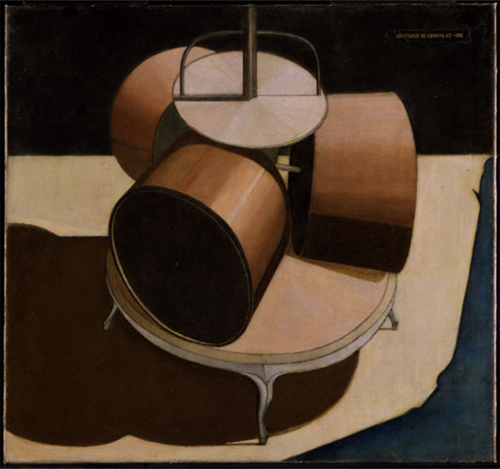
[Image: Marcel Duchamp's Chocolate Grinder (No.1) at the Philadelphia Museum of Art.]
Subscribe to:
Posts (Atom)