Saturday, 14 June 2014

On Why Duchamp Was Not A Dadaist


People often say that Duchamp was a Dadaist. He was not. He was already in New York in 1916 when Dadaism was being invented in Zurich, and by then had already completed many of the works that later got him associated with the Dadaist movement. He moved on the periphery of the movement and by his own testament had little to do with it. He once said of Dadaism that it "was parallel, if you wish" (in Pierre Cabanne, Dialogues with Marcel Duchamp). He made no attempt to ‘be a Dadaist’ when he moved back to Europe after World War I.

Duchamp also did not embrace the ‘pure meaninglessness’ of Dada. Dada was intended make thinking irrelevant by making it impossible. Duchamp
’s work is intended to make the spectator think.

Saturday, 31 May 2014

On the Search for the Waters of Oblivion


I saw this great (1812) painting by British Romanticist John Martin, entitled Sadak in Search of the Waters of Oblivion, when I was at the Saint Louis Art Museum (SLAM!) a few weeks ago. Sadak, who you can see clinging for dear life to the rock at the bottom of the painting, is a fictional character from a 1764 book by James Ridley, Two Tales of the Genii. Ridley published under the name 'Sir Charles Morell' and pretended to have translated the tale from Persian, although actually wrote it himself in English. It's good to see the painting at full scale. It's big and impressive, about 185 x 130 cm. The Saint Louis Art Museum store sells a t-shirt with just the detail of Sadak clinging to the rock, which I bought and am wearing as I write.

Tuesday, 27 May 2014

On the Passage from Virgin to Bride

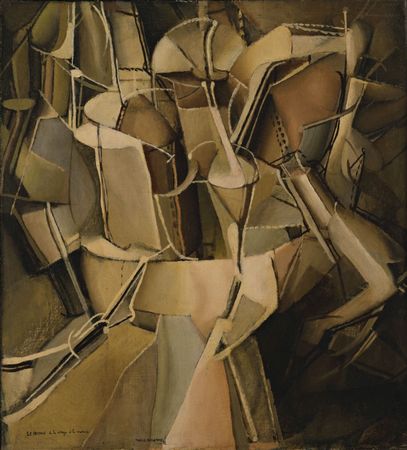
Duchamp's (1912) painting The Passage from Virgin to Bride (now at the MOMA in NYC) was one of his last paintings, the kind of art he would come to deride as 'retinal art'.

Although it is obviously very abstract, I think it actually looks fairly bride-like in miniature or from a distance, as this screen shot from Google search might make clear (I love the range of colors you get from doing a Google search for copies of 'the same image'):


Sunday, 11 May 2014

On a Penchant for Activities in the Pop Dada Vein


Following on from Jaap Blonk's recital of German Dadaist Kurt Schwitters' nonsense poem Ursonate (and as kind of a pop-culture equivalent), I really enjoy this take by Italian singer/comedian Adriano Celentano on what American English sounds like.

Thursday, 8 May 2014

On a Penchant for Activities in the Dada Vein


I appreciate Dutch performer Jaap Blonk's technologically-enhanced performance from memory of German Dadaist Kurt Schwitters'  nonsense poem Ursonate, which Schwitters developed over many years starting in 1925.


I also enjoy this description from the BBC website of Jaap Blonk:
    "His unfinished studies in physics, mathematics and musicology mainly created a penchant for activities in the Dada vein, as did several unsuccessful jobs in offices and other well organised [sic] systems."

Monday, 28 April 2014

On The 296,613 Anagrams of 'Philadelphia Freedom'


In Alice's Adventures in Wonderland, Lewis Carroll famously left a riddle unanswered: Why is a raven like a writing desk?
"Have you guessed the riddle yet?" the Hatter said, turning to Alice again.
"No, I give it up," Alice replied. "What's the answer?"
"I haven't the slightest idea," said the Hatter.
"Nor I," said the March Hare.
Alice sighed wearily. "I think you might do something better with the time," she said, "than wasting it in asking riddles that have no answers."
In a later edition Carroll offered an answer: Because it can produce a few notes, tho they are very flat; and it is nevar put with the wrong end in front! Alas,  a humorless copy editor ruined the best part of that joke by changing 'nevar' to 'never' before the edition was published, so the answer was never published as intended.

Another excellent answer was offered by 'puzzle maven' Sam Lloyd in 1914 (according to Cecil Adams' The Straight Dope): Because Poe wrote on both.

In my own novel, The Bride Stripped Bare By Her Bachelors, Even, there is a similar unanswered riddle. As the three main characters complete the first half of their road trip from Medford, MA by driving into Philadelphia, PA, one of them, Greg, plays Elton John's song Philadelphia Freedom. He asks the others: For ten points, and today’s grand prize, who can tell me what that song has to do with Duchamp? The chapter ends there; no answer is ever given.

Greg is obsessed with anagrams, for reasons that are partly to do with Duchamp, who greatly enjoyed anagrams and other wordplay. I asked my son to write me an anagram-finding computer program that could deal with long strings, which most on-line anagram tools cannot. There are at least 671 English words contained inside the string Philadelphia Freedom, and my son's program found 296,613 anagrams that used all the letters. I wrote my own computer program to help conduct a systematic search through this set, looking for an anagram that might serve as an answer to Greg's riddle. I found several candidates, but my son and I selected this one as our favorite:
LIMP? HAHA! DID LOPE FREE!
Duchamp's life can be seen a celebration of freedom, as a throwing off of all limitations. He never limped along but rather ran freely: i.e. he DID LOPE FREE.

Friday, 18 April 2014

On Caravaggio As (Like Duchamp) An Artist of Time


The narrator of my novel is an obsessive-compulsive guy named Isaac. Among a few other quirks, he is a devoted admirer of the Italian pre-Baroque painter Michelangelo Merisi da Caravaggio, now known most commonly just as Caravaggio, which is where he was from. Caravaggio was a master of chiaroscuro, painting which relies upon a strong contrast between light and dark. He arguably moved art toward modernity in a couple of ways, one of which is illustrated in this (c. 1595) painting, Boy Bitten By A Lizard. In an excellent little book on Caravaggio, Lambert (2000, p. 32) wrote of this painting that it "is a revolution in itself, marking the advent of the instantaneous in painting" (though also noting its inspiration in Sofonisba Anguissola's c. 1554 drawing Portrait of Her Son Asdrubale Bitten by a Crayfish, drawn for the more famous Michelangelo). This focus on time in painting allows us, perhaps, to draw a direct line between Caravaggio and Marcel Duchamp, whose (1912) Nude Descending A Staircase #2 deconstructed time into instantaneous pieces and then put them back together again. [On time and Duchamp, see also this post and this post.]

Sunday, 13 April 2014

On Samuel Beckett's Birthday


Although today, April 13th, is indisputably my own birthday (thanks for your congratulations), it might not actually be Samuel Beckett's birthday, despite what you may have read on your Twitter account or elsewhere today. It pleased Samuel Beckett to believe that he was born on a Friday that was simultaneously Good Friday and Friday the 13th: April 13th, 1906.

However, according to his biographer Anthony Cronin, Beckett's birth certificate indicates that he was born a month too late for such an auspicious entry into the world, on Sunday May 13th, 1906, with the birth being registered four weeks later, in June, as was customary. Of course, it might be an error on the birth certificate. The matter remains uncertain. In his biography Samuel Beckett: The Last Modernist Cronin writes "Since Beckett was on the whole truthful about such matters and on at least one occasion claimed to have the authority of his mother for the Good Friday birth-date, the balance of probability is in its favour, but it is a pity nevertheless that there should be any doubt about it."


[Image: Samuel Beckett at Riverside Studios (1984), a lithograph by Tom Phillips that is in the collection of England's National Portrait Gallery. The words are from Beckett's Worstward Ho, and have been adopted as a personal motto both by Phillips and by me.]

Monday, 31 March 2014

On Free Books

I'm giving away five free copies of my novel on GoodReads.com. Details below.


Goodreads Book Giveaway

The Bride Stripped Bare By Her Bachelors, Even by Chris F. Westbury

The Bride Stripped Bare By Her Bachelors, Even

by Chris F. Westbury

Giveaway ends June 10, 2014.
See the giveaway details at Goodreads.
Enter to win

Saturday, 29 March 2014

On the Final Cover of my Novel


My novel The Bride Stripped Bare By Her Bachelors, Even went to press yesterday. Here is the final cover, designed by Michael Kellner. I love the design: it captures the quirky, off-beat feel of the story and pays homage to Duchamp in many different ways.

The excerpt on the back is the following: 
    “It didn’t take me long to make friends with the
    museum guard, a muscular young red-haired Irish
    Bostonian named Bobby Sheridan. He sussed me out on
    my first vigil in front of the ivory carving. After
    I had been sitting in front of it for about an hour
    he came over to ask me if I was OK. I told him I
    was fine, very well actually, except for having a
    minor mental illness. I explained to him that I had
    obsessive compulsive disorder and couldn’t touch
    anything, and also that I didn’t have to work because
    my mother had died and I had inherited some money,
    enough to live for a while on but not really a lot.
    I explained to him that I was planning to spend many
    months in his museum, not touching anything of course
    but mainly just looking at a particular single piece
    of art, namely the carving of Abraham and Isaac that
    was in front of me. And I also let him know that I
    always wore pretty much the same clothes but that I
    changed my clothes and had a shower every day, and
    that I was very careful about cleanliness as part of
    my OCD. I drew his attention to some of the things
    I appreciated so much about the ivory
    carving, especially the ample bosom
    and translucent wings of the
    tiny angel.”

Monday, 24 March 2014

On Bear-Breed Spirit Depth

One of the main characters in my novel, Greg, is writing a book based on his master's thesis, called Bear-breed Spirit Depth: Duchamp, semantic multiplicity, and the artistic life.

The first part of his title is an anagram for The Bride Stripped Bare. That's Greg for you.

Greg's book plays no role in my plot, so there is nothing in my book to say what it contains. The thesis is about the bizarre flexibility of meaning. Greg points out that one lesson from Marcel Duchamp's work is that the meaning of objects is not contained only in those objects. Meaning diffuses outward from any thing, from any set of things, to new times, spaces, and concepts. A (copy of a) nearly-worthless (possibly entirely imaginary) typewriter cover in Paris, France one day is a renowned and highly-valued piece of art history in the National Gallery of Canada a few decades later.

Greg edits and writes very slowly. He feels no need to ever finish writing the book. He is happy to spread his delight in working on Bear-Breed Spirit Depth across decades.

Saturday, 15 March 2014

Saturday, 8 March 2014

On Doors Being Simultaneously Open and Shut

Perhaps one of Marcel Duchamp's most obscure pieces is his Door, 11 rue Larrey. This was a door that that Duchamp had a carpenter construct in 1927 in the corner of a room in Duchamp's apartment. Because of this location, the door closed one entrance when it opened the other, thereby contradicting the French proverb Il faut qu'une porte soit ouverte ou fermée ['A door must be either open or closed']. 

This reminds me of the fact that Duchamp once wrote in a letter to the French poet André Breton Pour moi il y a autre chose que oui, non et indifférent - C’est par example l’absence d’investigations de ce genre ['For me there is something other than yes, no, and indifferent - there is for example the absence of investigations of this kind.']

You can read more about Door, 11 rue Larrey here on www.toutfait.com.

Thursday, 6 March 2014

On The Heights Of Despair

I enjoy reading and re-reading Emil Cioran, the Romanian/French 'philosopher of despair'. Although he is certainly not as funny as Samuel Beckett (whom Cioran knew quite well) and not as open to the possibility of grace as Simone Weil (whom Cioran apparently never met), he shares that lightness of being that goes along with a deep appreciation for "the inconvenience of existence" (his own term). Here's a sampler of his work.
-------------

In major perplexities, try to live as if history were done with and to react like a monster riddled by serenity.
       The Trouble With Being Born

The intrinsic value of a book does not depend on the importance of its subject (else the theologians would prevail, and mightily), but on the manner of approaching the accidental and the insignificant, of mastering the infinitesimal.
       The Trouble With Being Born

A moment comes when it seems futile to choose between metaphysics and amateurism, between the unfathomable and the anecdote.
       The Trouble With Being Born

The ideal being? An angel ravaged by humor.
       The Trouble With Being Born

I shall be reconciled to myself only when I accept death the way one accepts an invitation to a dinner: with amused distaste.
       Drawn And Quartered

A book should open old wounds, even inflict new ones. A book should be a danger.
       Drawn And Quartered

The only explanation for the creation of the world is God's fear of solitude. In other words, our role is to amuse our maker.
       Tears And Saints

The dead center of existence: when it is all the same to you whether you read a newspaper article or think of God.
       Tears And Saints

No man of vice can be condemned unless he ceases to look upon vice as a pretext and turns it into a goal.
       On The Heights of Despair

One of the great delusions of the average man is to forget that life is death's prisoner.
       On The Heights of Despair