Reading about Yellowism made me think of Yves Klein's International Klein Blue (though International Klein Blue has more to do with blue than Yellowism has to do with yellow). This video homage to Yves Klein Blue by Jason Judd made me laugh. Nice work.
Thursday, 31 October 2013


On the Defense of Yellow Stuff


[Image: Paul Cézanne's 'The Card Players', a version of the most valuable painting on earth today, valued at between US$250,000,000 and US$300,000,000.]
Sunday, 27 October 2013
On the Treachery of Images
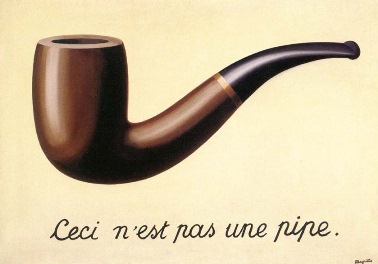
[Image: René Magritte's La trahison des images]
Sunday, 20 October 2013
On Remaking Duchamp's Readymade

I like this re-make of Duchamp's Fountain, entitled Nouveau Rendez-vous (New Meeting) by contemporary French artist Jerome Pierre, who has a lot of Duchampian-inspired pieces on his website.
Friday, 18 October 2013
On The Rape of the Sabines

This painting, The Rape Of The Sabines, by Nicolas Poussin (1594–1665) has always seemed powerful to me.
In part this is because I had a friend named Sabine when I first paid attention to it, and
I knew no other meaning of the word than that it was a woman’s first name. I
wondered if all the women allegedly being raped could possibly be named Sabine. Youth is difficult.

In fact (and now I speak with the full authority of
Wikipedia) the Sabines were a tribe
from whom the Romans abducted wives in 750 BCE, as attested to by, e.g. both Livy and Plutarch. The women in the painting weren’t actually
being raped in the modern sense of the word, but in the old sense of the word,
when rape (from the Latin root raptio meaning a large-scale abduction of women, as any careful reader of
Wikipedia already knows) meant...well, yeah, a large-scale abduction of women. Like Wikipedia said.
Despite my confusion about the victims and my early visual confirmation of the lack of any partially naked women in the painting (and by no
means implying either that rape and sex have anything more to do with each
other than that a woman must be partially naked or that violent mass abduction is in itself just an enjoyable spectator sport), this is an exciting and great painting. You’ll know
why if you go to the Louvre: this sucker is 1.6 metres by 2 metres (Americans:
that’s really big for an oil painting).
Enjoy.
Tuesday, 15 October 2013
On A Dozen New Episodes of 'Breaking Bad'
----- ----- -----
Lydia Rodarte-Quayle unexpectedly discovers that her old school buddy Jesus has just hired a new meth cook: Saul Goodman. At the same time, Hank Schrader has fallen in love with Badger. Sponsored by Ripley's 'Believe It Or Not'.
-----
Saul Goodman and Todd decide to blackmail Mike Ehrmantraut. Skinny Pete locks Mike Ehrmantraut into an organ donation container. Loosely based on the life of Bob Dylan.
-----
Steven Gomez and Marie Schrader meet in an airplane to discuss what to do about Gustavo Fring. Much to Walter White's surprise, Lydia Rodarte-Quayle hits Badger with a weapon carefully built using a piece of enamel screwed onto a piece of pine. Viewer discretion advised.
-----
Lydia Rodarte-Quayle unexpectedly discovers that her lover Ronnie has been accused of murdering Lydia Rodarte-Quayle. Meanwhile, some shady characters with federal government connections are asking questions about Lydia Rodarte-Quayle's income. Thanks to this masterful cast, the plot plays out better than it sounds.
-----
Walter White is surprised to learn that his old school buddy Otto is having sex with Skyler White. Meanwhile, Jesse Pinkman decides that it is necessary to kill Hank Schrader. Episode title: Exploding Heroine.
-----
Walter White, Junior and Walter White decide to start selling rosemary together. Much to Walter White's surprise, Lydia Rodarte-Quayle hits Steven Gomez with a weapon that Gretchen Schwartz has constructed using woven hair. Episode title: Culminating Synchronizing Pawn.
-----
Skyler White unexpectedly discovers that her colleague Cody has accidentally injured Marie Schrader. Meanwhile, Skyler White threatens Walter White's bottom. Gratuitous nudity adds little to this lacklustre work.
-----
Marie Schrader unexpectedly discovers that her lover Freddy is suing Skyler White. Meanwhile, Saul Goodman locks Mike Ehrmantraut into a canoe. Chaos ensues.
-----
In this surprising episode, Gretchen Schwartz and Marie Schrader decide to start selling crystal meth together. Much to Mike Ehrmantraut's surprise, Badger is planning to kill Todd. Episode title: Fen-sucked Swooning Dandelions.
-----
Marie Schrader unexpectedly discovers that her father-in-law Doyle has recently had drunken sex with Skyler White. At the same time, Badger starts studying genderization. Loosely based on the works of Oprah Winfrey.
-----
Gustavo Fring is surprised to learn that his mate Ernest already knows Skyler White. Much to Gustavo Fring's surprise, Gustavo Fring reluctantly decides that it is necessary to kill Gustavo Fring. Episode title: Stealing Dill.
-----
Skyler White is surprised to learn that her sweet lover Josh has a new meth cook: his eager neighbour, Sheree. Skyler White starts studying atheism. Great art direction.
Monday, 14 October 2013
On Charging To See Graffiti
Although this story of people charging other people to see a Banksy graffito is amusing in itself, the comments are perhaps the most interesting part, for several reasons. Some of the comments suggest that the people charging to view Banksy's alleged work (one of whom exclaims: "I could step on this shit; it don't matter to me") may in fact be part of Banksy's art. I would go further and say: even if they were not intended by the artist to be part of it, they are part of it now.
Duchamp would surely have approved of this intertwining of art and non-art, so close that you cannot even see the seams.
[Via BoingBoing]
Sunday, 13 October 2013
On Art As A Urinal
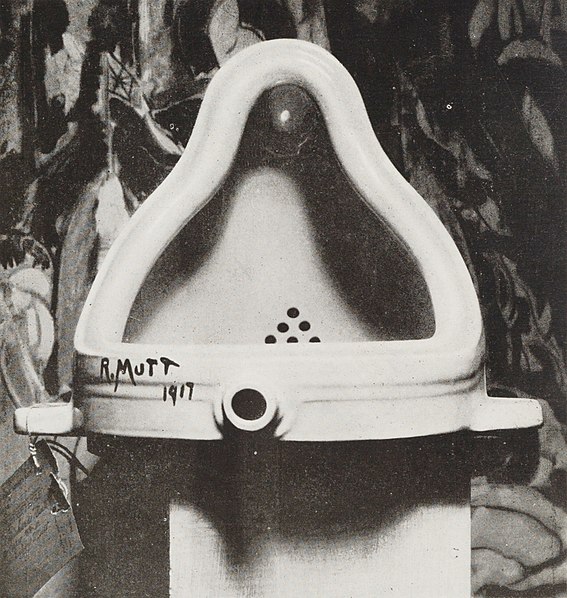
"When you stand close to 'beauty and truth', you realize it's just a bunch of old carved stone that some drunk fucker or gypsy has pissed on." Todd Babiak / Come Barbarians, p. 75
Perhaps Duchamp's most famous piece is his (1917) Fountain. This is the first work of his I ever heard of. It was featured in an anarchist calendar someone gave me when I was in my teens (and therefore, of course, an anarchist). Duchamp bought an ordinary urinal from a plumbing supply store (J.L. Mott Iron Works on Fifth Avenue in New York, if you're a details guy), signed it 'R. Mutt' and submitted it an exhibition organized by the Society of Independent Artists, who had agreed to show every piece submitted. They did not exhibit R. Mutt's urinal. Duchamp and his collector friend Walter Arensburg both resigned from the Society of Independent Artists in protest.
As my narrator Isaac put it succinctly in my novel: "Chaos and modern art ensued."
Saturday, 5 October 2013
On The Importance of Framing Things

The frame is a magnifying glass, a punctuation mark, an augmentive. It is a technology for sharing attention, sharing ideas. It invites viewers to linger carefully on something very particular. Anything deliberately (or, indeed, randomly) framed becomes imbued with more meaning than it had before framing. A framed leaf is not like a leaf fallen on the ground. The frame invites the viewer to consider the leaf, the worlds of all leaves, the universe of things leaves might make us think of, to meditate on all this, to understand the leaf as something more than just organic trash on the ground.
Framing anything augments that thing and makes its better, by reminding us to augment that thing and make it better.
[Image by Spanish artist Lorenzo Durán ]
Friday, 27 September 2013
On Seeing Patterns (On Vi Hart)
Everything I have seen by the 'mathemusician' ('mathemagician') Vi Hart has been mind-blowing and inspiringly brilliant, all presented in her very charming half-folksy, half-genius-showoff style. I particularly enjoyed this (30-minute long) clever meditation on 12-tone music/the nature of art/the insanity of copyright law/the psychology of pattern-finding. Highly recommended.
Wednesday, 25 September 2013
On Being Grateful For Small Things

At one particular low period of my life, I decided to make a list of things I liked. This turned out to be a very instructive exercise. Many things that made the list were things that I already had or that were very easy to obtain, so the world started to seem quite manageable. After I made the list, I started eating a lot of pre-cut pineapple, which I could buy at my local grocery store. It cheered me up greatly. It is so nice when someone else cuts up fruit for you.
Here's a selection of good things from my list.
- Drinking earthy red wine
- Watching epic films that take place in ancient times
- Having it rain when I am supposed to water the lawn
- Beauty
- Exquisitely detailed bone or ivory carvings
- Religions that have a different God for every human need
- Probability theory
- Having stereo speakers in the kitchen
- Visiting extremely populous cities
- The quality of the light at twilight
- Anything sour with lime
- Solo piano music
- Witticisms
- Stocks with a P/E ratio under 10
- Good teeth
- Digital cameras
- The computer language LISP
- The incense they use in Catholic cathedrals
- Basil, fresh ginger, and garlic
- Japanese furniture
- Dishwashers
- Chocolate that is at least 70% cocoa
- Hammocks in the woods
- Walking in old growth forests
- Floating on my back in the ocean like a piece of driftwood
- Sleeping
- Having an umbrella with me when it rains
- Old trees
- The art of Tom Phillips
- A high speed Internet connection on a cell phone
- Drinking Calvados after a meal
- Ouzo
- The Montreal Jazz Festival
- Seeing people I love smiling
- Eating Greek lamb
- Politeness
- 'Bring your own wine' restaurants
- Bonsai trees that are older than I am
- Champagne
- Public displays of affection
- Watching the ocean from the back of a boat
- Things that are dappled by the sun
- Rice paddies at sunset
- Five-year light bulbs
- Automatic garage door openers
- Goat cheese
- Portabello mushrooms
- Indian, Japanese, and Thai food
- Spring skiing
- Salt and vinegar potato chips
- Seeing my friends in love
- Generous hosts
- Bed quilts when it is cold
- Soft beds
- Ludwig Wittgenstein
- Fyodor Dostoyevsky
- Monty Python
- Travelling without a goal (the dérive)
- Nectarines that are perfectly ripe so the pit falls right out when you cut them in half
- Pre-cut mango and pineapple
- Recursion
- Idealists
- Cruise control
- The game of 'Go'
Saturday, 21 September 2013
On Loving John

I really love this (1513) painting by Leonardo da Vinci of Saint John The Baptist, which hangs in the Louvre.
Friday, 20 September 2013
On Self-surgery

I admire these people intensely. They make me proud to be a human being.
It is interesting to think about why this is so.
Saturday, 14 September 2013
On Hidden Noise

The idea of hidden noise plays a role in my novel The Bride Stripped Bare By Her Bachelors, Even in various ways. There are always unknowns inside things and people, even inside ourselves. At one point my narrator, named Isaac (though he has another name too), discusses the value of Duchamp's piece:
“What dollar value can we put on the ball of faded boric twine known as With Hidden Noise? It is impossible to answer. Duchamp made the only copy of the piece for his friend Walter Arensburg. Arensburg donated it to the Philadelphia Museum of Art where it remains today. It has never been put on the market. In the normal sense of the word, the piece has no value at all. Only market price determines the value of art. With Hidden Noise has never had a market. It is art that does not act like art.
When Duchamp was asked if he knew how much Arensburg had paid for his fabulous painting Nude Descending a Staircase (which was $240, in case you are wondering), Duchamp replied “No, I wasn’t interested. I never knew the price.” He went on to add: “It’s the same for With Hidden Noise...what’s secret is the price!”
It pleased him to be unable to say what anything was worth.
If it went on the art market today, would With Hidden Noise be worth as much as one million dollars?
Oh yes.
C’mon.
Man.
Let’s be serious.
Oh yes.
I am definitely sure that With Hidden Noise is worth much more than a million dollars. I can be definitely sure because, if it went on the market today for just a million bucks, I would sell my house so I could buy it.”
Tuesday, 10 September 2013
On Things Not Being What They Seem To Be

Claes Oldenburg's (1962) Ghost Drum Set is one piece of visual art I have always loved, ever since I saw it at the George Pompidou museum in Paris when I was in my 20s (many decades ago now). There is always something a little bit thrilling about things that just cannot be what they nevertheless seem to be (Oldenburg's speciality).
Subscribe to:
Posts (Atom)